Different people, different plans: keep your circle organised in Telegram
TasksNet · Updated
Your travel partner, a colleague and a customer all write in Telegram. Their conversations sit together, but their responsibilities belong to different plans. TasksNet contacts give you a way back to each person's shared work. Projects define where you cooperate; your own task list keeps the actions you have accepted in view.
Start with the person and the agreement
Suppose Anna is organising a trip with you and Ben is preparing a customer order. Anna needs the apartment booking; Ben needs the final artwork. A contact list helps you find the right person, while separate projects keep those two plans from becoming one mixed discussion.
A contact is a connection, not blanket permission. Adding someone does not expose your private tasks or automatically place them in every project. Decide who needs each context. This makes the arrangement useful for small, changing circles rather than only a permanent team.
Open Contacts and find shared work
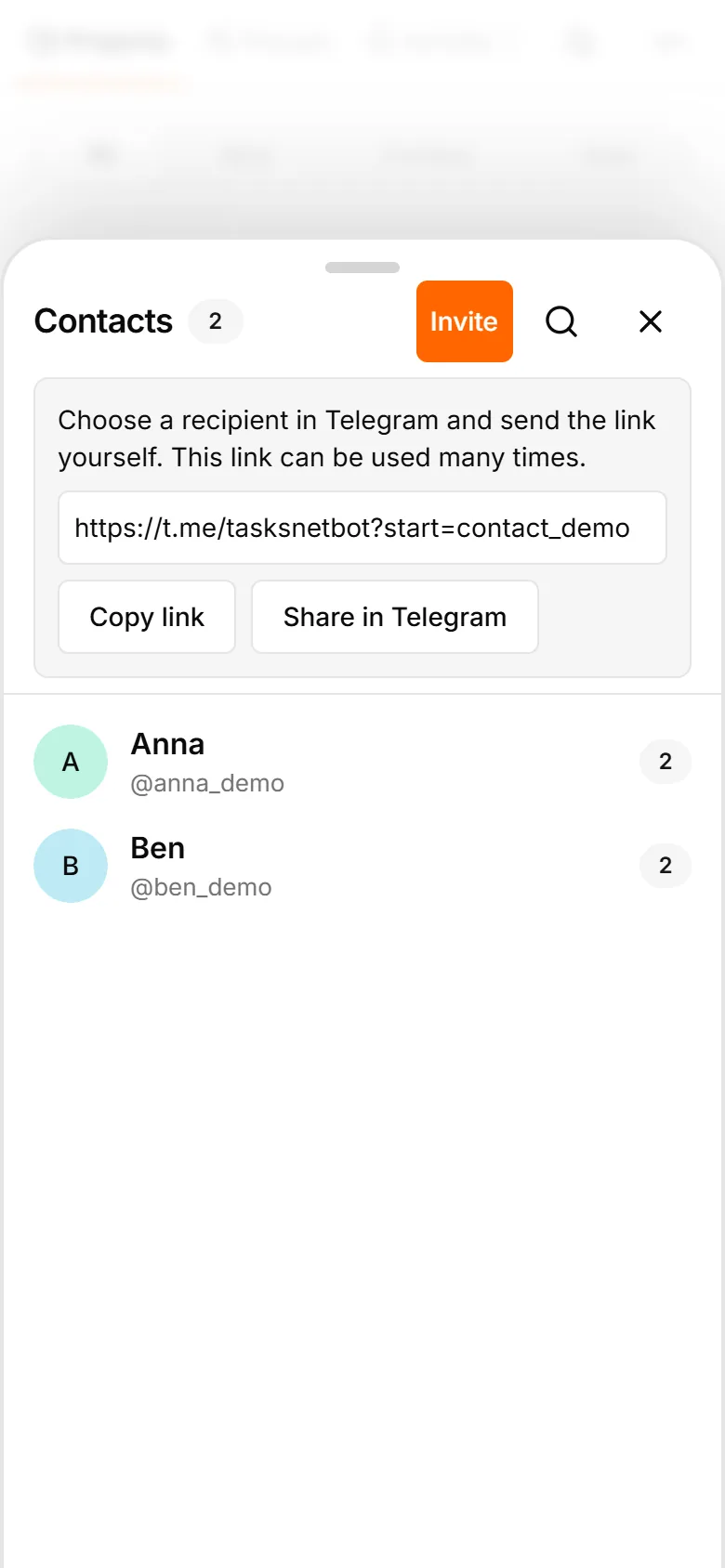
Open Contacts in the Mini App. Find the participant and open their task view. You see the work available in your shared contexts and your outgoing personal handoffs, not a copy of that person's private planner. Review the task title and responsibility before asking for an update.
For example, checking Anna's booking action can answer whether a decision is still needed. Her private shopping list remains outside this view. Use the task's own discussion for questions that belong to it, so the next review has the relevant answer beside the action.

Invite someone you want to work with
Use the contact invitation workflow when the person is not yet in your circle. Share the invitation through Telegram and let the recipient open it and sign in. An invitation link does not prove that someone has joined; check the resulting connection in the application.
Contact invitations do not provide a paid subscription. Each participant needs their own Premium for collaborative actions. You can establish a connection without pretending that a contact automatically has permission to change a particular project or task.
Use a separate project for each common result
Create one project for the trip and another for the order. Add the appropriate participants explicitly. In a project linked to a group, the person needs both project membership and current group access. Being in the larger Telegram chat alone does not join the project.
Assign concrete actions and check acceptance where required. Mine collects your personal tasks and confirmed work assigned to you. To oversee Anna's and Ben's actions, open their shared context or the whole project. Those are different questions from “What should I do today?”

Keep a small circle useful
Review a contact's work before sending a vague “Any news?” message. If the task is blocked, clarify the next action in its comments. If the agreement changes, update the relevant task or project rather than creating another disconnected promise in chat.
Start with two people and two separate plans. Add only the tasks you genuinely share and give each one a clear outcome. You can expand the circle as new work arrives, while the permission boundaries continue to follow each project and personal conversation.